Visual Privacy-Preserving Fall Detection
An experimental fall-detection project comparing transformer- and CNN-based computer vision models while considering the privacy implications of visual monitoring.
- Jan 2026 — Aug 2026
- Researcher and Developer
Overview
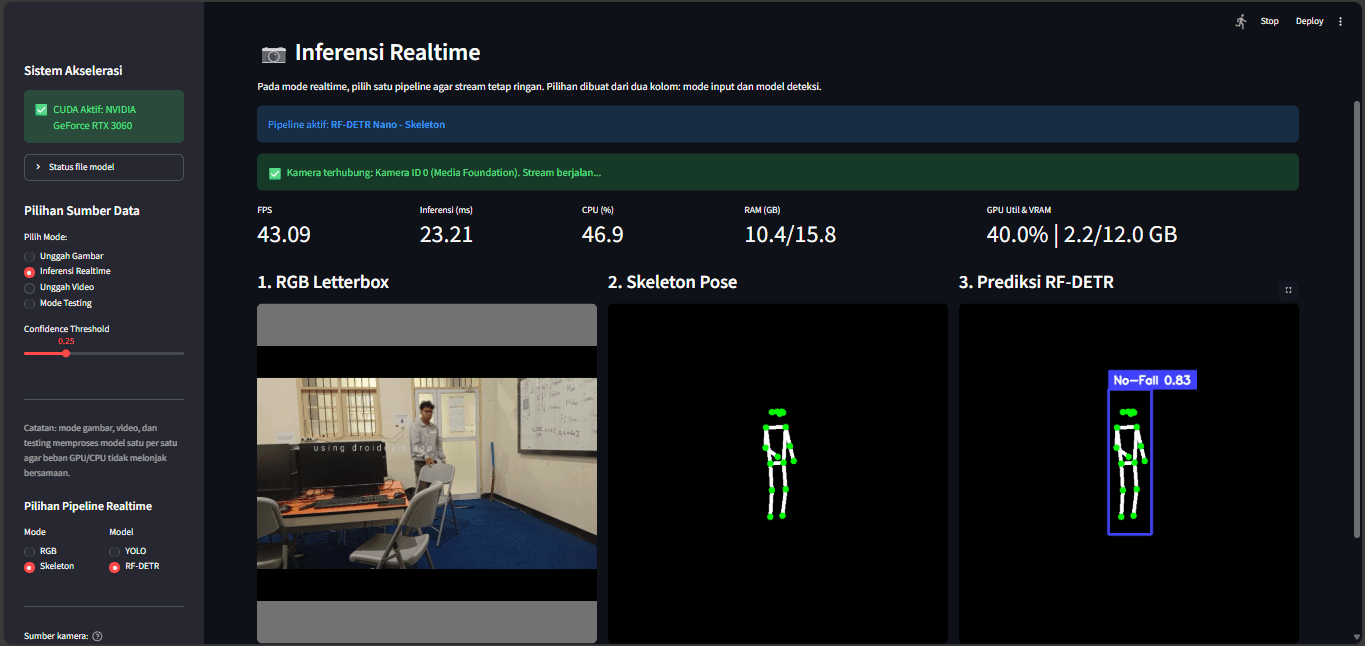
Visual Privacy-Preserving Fall Detection is a research project exploring how computer vision can be used to detect fall events while considering the privacy implications of visual monitoring.
The project compares two object-detection approaches: RF-DETR, which uses a transformer-based architecture, and YOLOv11, which follows a CNN-based approach.
Role
Researcher and Developer
Technology
What I Learned
This project showed me that transformer-based computer vision models can be a practical alternative to CNN-based models for detection tasks.
It also helped me understand that model performance depends on more than the architecture alone. Dataset characteristics, training configuration, evaluation methods, and deployment conditions all influence the final results.
What I Explored
Through this research, I developed a practical understanding of how artificial intelligence models—particularly computer vision models—are trained, evaluated, and compared.
I also explored whether a transformer-based computer vision model could perform effectively for fall detection when compared with a more established CNN-based approach.
Model Comparison
I compared RF-DETR and YOLOv11 under the same laboratory evaluation context. During this evaluation, RF-DETR performed reliably and achieved stronger results than YOLOv11 under the tested conditions.
These findings are specific to the dataset, training configuration, and evaluation metrics used in this research. They should not be interpreted as evidence that one architecture will always outperform the other in every environment.
Current Status
The results currently represent a laboratory evaluation. Further testing is required to understand how the models perform in more varied and real-world environments.